
Drug pump therapy is an advanced treatment option for chronic pain patients who haven’t achieved enough pain relief with other treatments. Drug pump therapy is known by many other names, such as pain pump therapy, intrathecal drug delivery, spinal drug delivery, infusion pump therapy, intraspinal drug therapy and spinal analgesia. Drug pump therapy is also used to treat severe spasticity.
What is a Drug Pump?
A drug pump is an implanted medical device that delivers medication directly into the intrathecal space, the space inside the spinal canal that contains the cerebrospinal fluid (CSF), which surrounds the spinal cord.
The device consists of a pump with a reservoir and a catheter:
- The reservoir is the space inside the pump in which the drug is stored. The pump has a reservoir fill port via which drug is removed or refilled using a needle.
- The catheter is a thin, flexible tube through which the drug is delivered. It is inserted into the intrathecal space along the spine.
- The pump delivers the drug from the reservoir to the catheter and thus to the intrathecal space. Pumps may be mechanical or battery-operated.
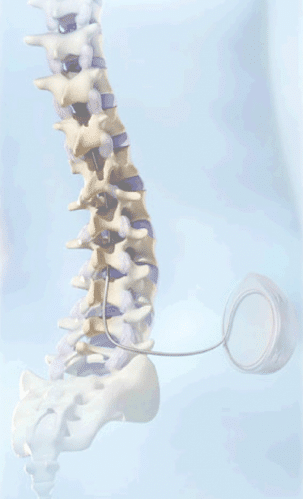
- Mechanical pumps, also known as fixed-rate pumps, deliver a continuous amount of drug at a consistent flow rate. The pumping action is completely mechanical. It is driven by a gas pressure chamber and does not require a battery/electricity to operate.
- Battery-operated pumps, also known as variable-rate pumps, are electronic pumps that can be programmed so that the amount and timing of drug delivered can be adjusted. The daily drug schedule can be programmed to suit each patient’s specific daily requirements and their changing needs. Some newer drug pumps also allow patients to self-administer a controlled dose of drug for breakthrough pain attacks. Battery-operated pumps need to be replaced once the battery runs out of charge.
What Drugs are Used?
- Morphine is the gold standard for the treatment of chronic pain and the only opioid approved by the U.S. Food and Drug Administration (FDA) for intrathecal therapy.
- Hydromorphone is a commonly used alternative to morphine, though it is not FDA-approved.
- Ziconotide is a synthetic form of a peptide found in the venom of the marine cone snail. It is FDA-approved for intrathecal treatment of severe chronic pain and may be used in patients who can’t tolerate intrathecal morphine.
- Baclofen is an FDA-approved intrathecal drug for the treatment of severe spasticity, muscle spasms, and neuropathic pain.
- There are other medications used for intrathecal drug pump therapy, however they are not FDA-approved.
How Does Drug Pump Therapy Work?
The spinal cord is surrounded by three layers of protective tissue (see the diagram below). These are the dura mater, the arachnoid mater, and the pia mater. The intrathecal space is the space between the arachnoid mater and pia mater, which contains the CSF. The CSF delivers nutrients to the spinal cord and removes waste products. Drugs delivered into the intrathecal space can easily diffuse across the pia mater and move into the spinal cord.
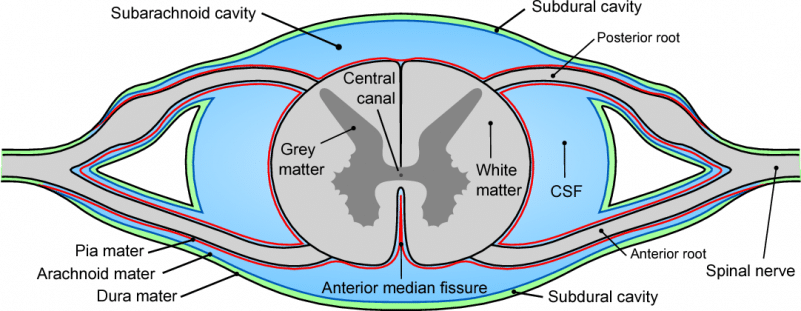
[Cross section of the spinal canal showing the spinal cord in the middle (grey) and the intrathecal space containing the CSF (blue)]
The spinal cord contains various receptors that are involved in pain signalling. Different drugs will bind to different receptors.
Opioids
Opioid drugs (i.e. morphine and hydromorphone) bind to opioid receptors, which are found on neurons (nerve cells) within the spinal cord. Activation of opioid receptors causes the neurons to stop releasing neurotransmitters and therefore blocks the transmission of pain.
Ziconotide
Ziconotide is a powerful pain suppressor. It works by reducing the release of pro-nociceptive neurotransmitters in the dorsal horn of the spinal cord, which is where sensory nerves enter the spinal cord, and hence where pain signals are transmitted to the central nervous system.
Baclofen
Baclofen is a muscle relaxant that binds to the GABAB receptor. It is used to treat painful muscle spasms, such as those caused by spinal cord injury.
Who is it for?
Drug pump therapy may be appropriate for carefully selected patients with severe chronic pain, including cancer or non-cancer pain, neuropathic or nociceptive or mechanical pain. Drug pump therapy is also used to treat severe spasticity. Patient suitability for intrathecal therapy requires an in-depth medical assessment.
The Polyanalgesic Consensus Conference (PACC) lists the following conditions for intrathecal drug therapy:
| Indications for Drug Pump Therapy |
|---|
|
Drug pump therapy is also useful in patients who are taking high doses of opioid medications, but who are not getting enough pain relief, and/or are experiencing significant side effects with these medications. Because the drug is delivered directly to the intrathecal space, the same level of pain relief can be achieved with much smaller amounts of drug delivered intrathecally, compared to oral administration. This also means that side effects are minimised and any systemic (whole body) side effects that would be caused by oral administration are avoided.Usually, intrathecal therapy is recommended for patients who have tried a number of medications and other treatment options, but have not achieved enough pain relief. Drug pumps may be recommended for patients who are not suitable for spinal cord stimulation, or who have not achieved adequate pain relief with spinal cord stimulation (trial or implant).
What is Involved?
Trialing
Before a drug pump is permanently implanted, intrathecal therapy may be trialed. In some cases, the doctor may decide not to do a trial and proceed straight to implant.
There are different methods of trialling intrathecal therapy. The simplest method is a “single bolus injection” trial, in which a needle is used to inject a single volume of drug into the intrathecal space.
Some patients will need repeat injections (multiple bolus trial). For this, a temporary catheter may be placed into the intrathecal space and drug injected externally via the catheter. The catheter is inserted directly into the intrathecal space through a spinal needle inserted into the back of the spine. Under x-ray guidance, the catheter is threaded through the needle and positioned at the level in the spine that corresponds to the patient’s area of pain.
A continuous infusion trial is where drug is infused via catheter over a specified period of time in a day surgery setting.
After the trial, the doctor and patient will discuss whether the trial was successful (i.e. did it provide enough pain relief, did it help with physical function and activity, were there any side effects) before deciding whether to proceed to implant of a drug pump.
Implant
Implantation of the drug pump is a minor surgical procedure that is performed in an operating theatre under general anaesthesia or local anaesthesia with sedation. The catheter is inserted into the spine as described in the trial procedure. The pump, however, is usually implanted into the lower abdomen. An incision is made and a “pocket” is created for implantation of the pump between the skin and the muscle tissue. A “tunnelling tool” is then used to move the loose end of the catheter from the back, where it was inserted, around the body internally and into the abdominal pocket. The catheter is then connected to the pump, the pump is implanted, and all surgical incisions are closed.
Pump Refills
Drug pumps are usually refilled every 3-6 months, although this will depend on the drug schedule. Refills are performed in the clinic, with or without the use of medical imaging (i.e. X-ray fluoroscopy or ultrasound). The pump is accessed externally. A needle is inserted into the skin at the implant site and directed into the pump reservoir fill port. Any remaining drug is removed via needle and syringe before the pump is refilled with new drug.
How Safe is it?
As with any invasive therapy, drug pump therapy comes with risks associated with surgery and having an implanted device. This makes drug pump therapy unsuitable for some patients.
The side effects of the drug itself will depend on which drug is used. For intrathecal morphine, the most common side effects are lethargy, fatigue and sweating.
If required, a drug pump can be switched off or removed (explanted).
Clinical Trials
Genesis Research Services conducts medical device clinical trials for various chronic pain conditions. To view currently recruiting studies, click here or call us on (02) 4985 1860. If the current studies aren’t suitable for you, you may register your interest for future studies by clicking here.
References & Resources:
1. “About Neurostimulators and Drug Pumps: Chronic Pain” (accessed 10/10/2018): https://www.medtronic.com/uk-en/patients/treatments-therapies/drug-pump-chronic-pain.html
2. Bagnall D. “The use of spinal cord stimulation and intrathecal drug delivery in the treatment of low back-related pain”. 2010; 21(4): 851-858. https://www.ncbi.nlm.nih.gov/pubmed/20977968
3. Bolash R & Mekhail N. “Intrathecal Pain Pumps: Indications, Patient Selection, Techniques, and Outcomes”. 2014; 25(4): 735-742. https://www.ncbi.nlm.nih.gov/pubmed/25240660
4. Deer TR, et al. “The Polyanalgesic Consensus Conference (PACC): Recommendations on Intrathecal Drug Infusion Systems Best Practices and Guidelines”. 2017; 20(2): 96-132. https://onlinelibrary.wiley.com/doi/abs/10.1111/ner.12538
5. Deer TR, et al. “The Polyanalgesic Consensus Conference (PACC): Recommendations for Trialing of Intrathecal Drug Delivery Infusion Therapy”. 2017; 20(2): 133-154. https://onlinelibrary.wiley.com/doi/abs/10.1111/ner.12543
6. Deer TR, et al. “The Polyanalgesic Consensus Conference (PACC): Recommendations for Intrathecal Drug Delivery: Guidance for Improving Safety and Mitigating Risks”. 2017; 20(2): 155-176. https://onlinelibrary.wiley.com/doi/abs/10.1111/ner.12579
7. Ghafoor VL, et al. “Intrathecal drug therapy for long-term pain management”. 2007; 64(23): 2447-2461.
https://academic.oup.com/ajhp/article-abstract/64/23/2447/5135084
8. Hayek S. “Methods of Trials for Consideration of Intrathecal Drug Delivery Systems”. (accessed 17/09/19): https://www.asra.com/page/222/methods-of-trials-for-consideration-of-intrathecal-drug-delivery-systems
9. McDowell GC. “Intrathecal Drug Delivery For Spasms or Chronic Pain”. 2018; last updated 26 February 2018 (accessed 16/10/2018): https://www.neuromodulation.com/fact_sheet_intrathecal_drug_delivery
10. Pope JE, et al. “Clinical Uses of Intrathecal Therapy and Its Placement in the Pain Care Algorithm”. 2016; 16(8): 1092-1106. https://onlinelibrary.wiley.com/doi/full/10.1111/papr.12438
11. Saulino M, Kim PS & Shaw E. “Practical considerations and patient selection for intrathecal drug delivery in the management of chronic pain”. 2014; 7: 627-638. https://www.ncbi.nlm.nih.gov/pmc/articles/PMC4234284/
12. Sheth S. “Intrathecal or Intraspinal Drug Delivery (IDD)”. 2016; last updated 30 May 2018 (accessed 10/10/2018): https://www.neuromodulation.com/pump
13. Smith HS, et al. “Intrathecal Drug Delivery”. 2008; 11: S89-S104. http://www.painphysicianjournal.com/linkout?issn=1533-3159&vol=11&page=S89
14. Spine image by BruceBlaus [CC BY 3.0 (https://creativecommons.org/licenses/by/3.0)], from Wikimedia Commons.
15. Intrathecal pump image adapted from: Bhatia G, et al. “Intrathecal Drug Delivery (ITDD) systems for cancer pain”. 2013; 2: 96. [CC BY 3.0 (https://www.ncbi.nlm.nih.gov/pmc/articles/PMC3892916/)].